The Wild Ponies of Assateague Island National Seashore, Maryland
Assateague Island National Seashore · Maryland District (near Berlin & Ocean City)
Wild horses on the Maryland end of a windswept barrier island, just minutes from Berlin. No need to drive to Virginia.
Pony viewing on Assateague Island · about 4:30 PM
Around 4:30 this afternoon we’ll be out on Assateague Island looking for the wild ponies. Late afternoon is a pleasant time to drive the park roads and check the marshes and bayside, where the horses spend much of their day grazing. Bring binoculars or a zoom lens, and remember to stay at least 40 feet away.
Maryland entrance: 7206 National Seashore Ln, Berlin, MD 21811 · Open in Google Maps →
Head to the Maryland side. This page is about the Maryland District of Assateague Island National Seashore, near Berlin. Take Route 611 south from Route 50 (about 8 miles south of Ocean City) and cross the Verrazano Bridge onto the island; the Maryland entrance is at 7206 National Seashore Ln, Berlin, MD 21811 · (410) 641-1441. The Virginia end of the island (Chincoteague National Wildlife Refuge, near Chincoteague, VA) is a separate destination: the National Park Service notes there is no vehicle access between the two entrances on the island, so you’d have to go back to the mainland and drive around, roughly 50–60 miles and about an hour or more each way. Don’t route your GPS to Chincoteague or Virginia.
At a glance
Getting to know the ponies
Tough, wild and free
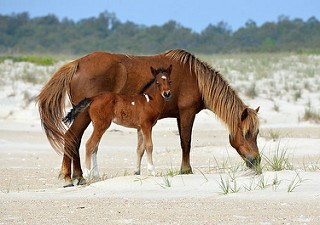
A mare and foal grazing beach vegetation (NPS photo)
Though everyone calls them “wild,” the National Park Service explains they are feral: descendants of domestic horses. They have adapted to scorching heat, mosquitoes, storms and poor-quality food, and live in small bands of two to twelve horses, each with its own home range. They graze mostly on saltmarsh cordgrass, plus beachgrass, greenbrier and even poison ivy.
Two herds, one island
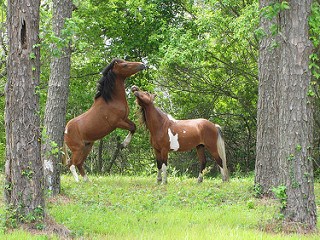
Young stallions playing on Assateague (NPS photo)
A fence at the Maryland–Virginia state line splits the horses into two herds. The Maryland herd, the one you’ll see on this visit, roams freely across the whole Maryland District of Assateague Island National Seashore and Assateague State Park. The Virginia herd, the famous “Chincoteague ponies,” lives far to the south inside large fenced areas of the Chincoteague National Wildlife Refuge.
Shipwreck legend vs. history
Local folklore says the horses swam ashore from a Spanish galleon wrecked off the Virginia coast. It’s a great story, but the Park Service notes there are no records that confirm it. The most likely explanation: in the late 1600s, mainland owners put horses out on barrier islands like Assateague to avoid fencing laws and taxes on livestock.
Care and management
National Park Service
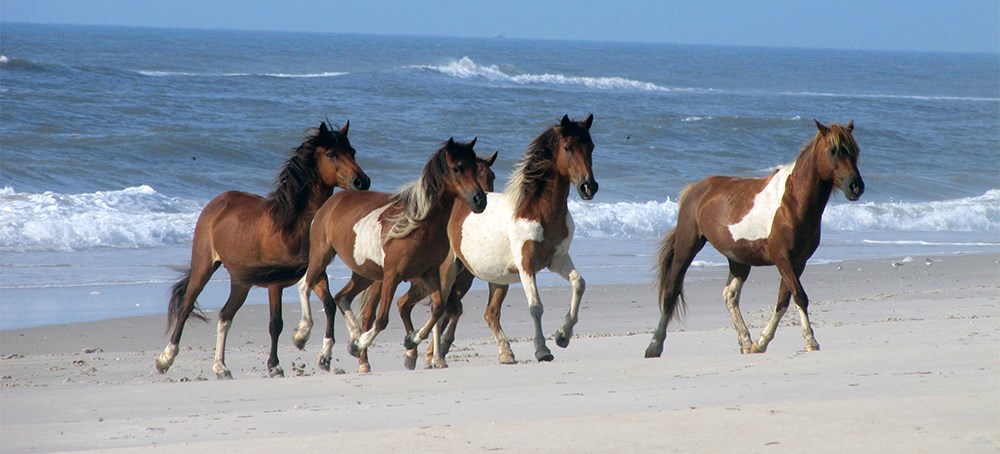
Maryland horses escaping the bugs on the beach (NPS photo)
The Park Service owns and manages the Maryland horses as a wild population. Their numbers grew from about 28 in 1968 to more than 165 by 1997, and overgrazing began damaging dunes and marshes. Since 1994 the herd has been managed with a non-hormonal contraceptive vaccine, delivered by dart, to keep it at a healthy size (a target of roughly 120–150 horses at the time).
Chincoteague Volunteer Fire Company
At the Virginia end of the island (not part of this visit), the fire company owns the Virginia ponies and grazes them on the refuge under a U.S. Fish & Wildlife Service permit that caps the herd at about 150 adults. About 50 are kept in an area south of Beach Road where the public can see them; the rest live farther north.
Pony Penning & the Pony Swim
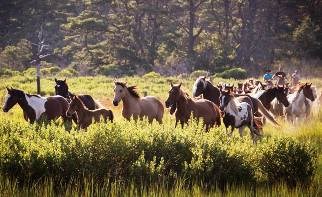
Saltwater Cowboys round up the Virginia herd (NPS photo)
On the last Wednesday of July, the “Saltwater Cowboys” swim the Virginia herd across Assateague Channel to Chincoteague Island, where vets check them. Most foals are auctioned the next day to keep the herd size in check and raise money for the fire company. A few “buyback” foals are returned to the island to live out their lives. This all happens in Virginia, not on the Maryland side. The tradition was made famous by Marguerite Henry’s book Misty of Chincoteague.
Best ways to see them on the Maryland side
- Drive the park roadsAs you come down off the Verrazano Bridge you enter horse territory. Watch along Bayberry Drive and Bayside Drive, the marshes, beaches, campgrounds and parking lots.
- Check the marshes and baysideHorses spend most of the day grazing and moving slowly between feeding areas.
- Walk the nature trailsThree short Maryland trails: Life of the Marsh (1/2-mile loop), Life of the Forest (1/2-mile loop) and Life of the Dunes (3/4-mile loop).
- Assateague State Park areaThe Maryland herd also roams Assateague State Park, right next to the National Seashore at the north end of the island.
- Season mattersIn summer they stay near the developed areas and beach; in fall and winter they spread out down the island.
- Chincoteague is a different tripThe Virginia herd lives in Chincoteague National Wildlife Refuge at the far south end of the island. There is no road along the island between the Maryland and Virginia entrances, and the drive around is about an hour or more. Stay on the Maryland side for this visit.
- Maryland District entrance$25 per vehicle for 7 days; walk-in or bike is free. Open 24 hours; visitor center 9am–5pm.
- State Park is separateAssateague State Park (next door, run by Maryland) has its own entrance fees, and State Park passes are not valid in the National Seashore.
Tips for visitors
Give them space
Stay at least 40 feet away (about a bus length). That’s the legal minimum, and often still too close. If horses walk toward you, back off and return to your car. Never feed or pet them: they bite and kick, can carry rabies, and citations can be issued.
Drive slowly
Horses cross and stand in the roads. Keep your speed down, roll your windows up if horses approach, and don’t open trunks or coolers when they’re nearby. Horses that learn to beg along roads are the ones most often hit by cars.
Plan ahead
On the Maryland side, pets are allowed only in certain areas, on a leash no longer than 6 feet, and not on nature trails or the lifeguarded beach. Bring bug spray, water and sunscreen, and a zoom lens or binoculars for great photos from a respectful distance. Sightings are likely but never guaranteed.
Sources: NPS: Assateague’s Wild Horses · NPS: Safety tips · NPS: Fees · NPS: Directions · NPS: Pets · Chincoteague ponies (Virginia background)